
Robotic Joint Replacement
Ethical, Compassionate and comprehensive Orthopaedic care
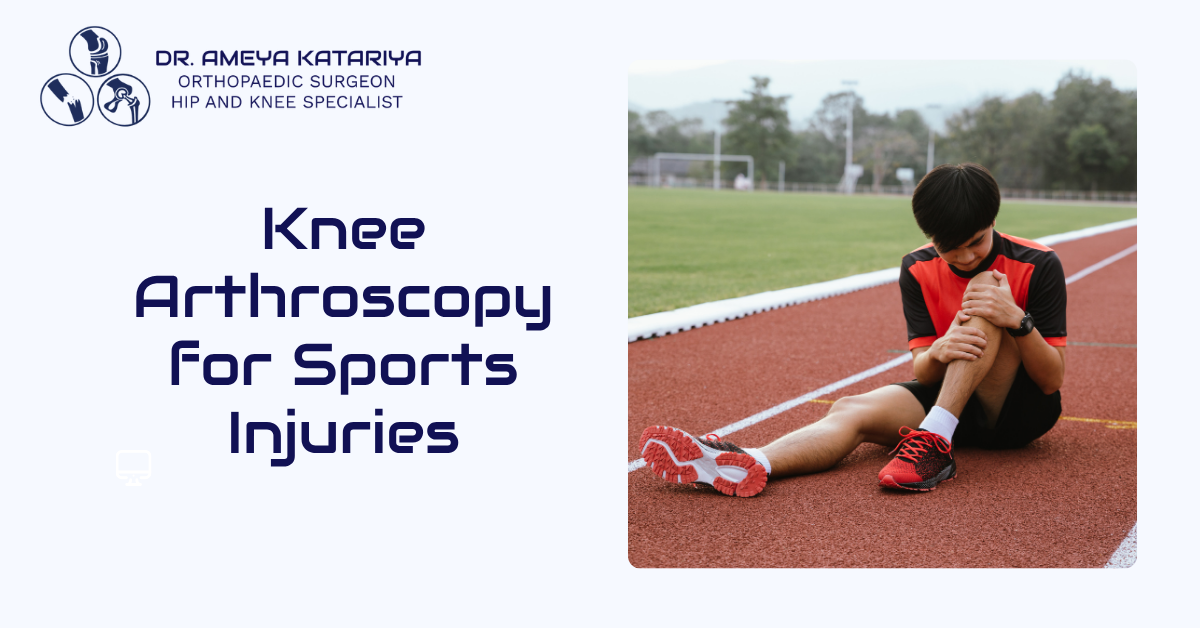
Sports injuries can affect knee stability, movement, and performance. Injuries such as meniscus tears, ACL injuries, cartilage damage, and ligament problems are common among athletes and physically active individuals.
When non-surgical treatments do not provide adequate relief, knee arthroscopy may be recommended. It is a minimally invasive procedure that allows an orthopaedic surgeon to diagnose and treat problems inside the knee joint through small incisions.
Dr Ameya Katariya, Fellowship-trained Hip and Knee Orthopaedic Surgeon in Pune, specialises in advanced knee care and helps patients return to their active lifestyle with personalised treatment plans.
Knee arthroscopy is a minimally invasive surgical procedure where a small camera called an arthroscope is inserted into the knee joint through a tiny incision.
The arthroscope provides a clear view of the internal structures of the
knee, allowing the surgeon to identify and treat conditions affecting:
• Meniscus
(knee cartilage)
• Anterior cruciate ligament (ACL)
• Posterior cruciate
ligament (PCL)
• Articular cartilage
• Synovial tissue
Compared to traditional open knee surgery, arthroscopy involves smaller incisions, less tissue damage, and generally faster recovery.
The meniscus acts as a cushion between the thigh bone and shin
bone. Sudden twisting movements during sports can cause meniscus tears, leading
to:
• Knee pain
• Swelling
• Clicking or locking
sensation
• Difficulty bending the knee
Arthroscopy can help repair or remove the damaged portion of the meniscus depending on the injury.
The ACL helps maintain knee stability during running, jumping, and
sudden direction changes. ACL injuries are common in sports like:
•
Football
• Basketball
• Cricket
• Tennis
Arthroscopic ACL reconstruction can restore knee stability and help athletes safely return to sports.
Damage to knee cartilage can cause pain, swelling, and reduced movement. Arthroscopy allows surgeons to assess cartilage damage and perform suitable procedures to improve joint function.
Small fragments of cartilage or bone inside the knee joint can
cause:
• Catching sensation
• Locking of the knee
• Pain
during movement
Knee arthroscopy can remove these loose fragments and improve mobility.
Knee arthroscopy offers several advantages compared to traditional open surgery:
The procedure uses small cuts, resulting in minimal scarring and reduced tissue damage.
Patients generally experience quicker recovery compared to conventional knee surgery, depending on the type and severity of injury.
Because it is minimally invasive, post-operative discomfort and swelling are often reduced.
The surgeon can directly visualize the knee joint and treat the problem during the same procedure.
With proper rehabilitation, many athletes can gradually return to sports and physical activities.
Recovery after knee arthroscopy depends on:
• Type of injury
treated
• Procedure performed
• Patient’s age and fitness level
•
Rehabilitation progress
Patients may experience mild swelling and discomfort. Physiotherapy exercises are usually started early to restore knee movement and strength.
During this phase, focus is placed on:
• Improving knee
range of motion
• Strengthening muscles around the knee
• Regaining
normal walking ability
Return to sports depends on the specific procedure:
| Procedure | Approximate Recovery Time |
|---|---|
| Minor meniscus treatment | Few weeks |
| Meniscus repair | 3–6 months |
| ACL reconstruction | Around 6–9 months |
| Cartilage procedures | Several months |
A structured rehabilitation program is essential for a safe return to sports.
You should consult a knee specialist if you experience:
•
Persistent knee pain after a sports injury
• Repeated knee
swelling
• Knee instability or giving way
• Locking or clicking
sensation
• Difficulty performing sports activities
• Failure of
medicines and physiotherapy to improve symptoms
Early evaluation can help prevent further damage and improve treatment outcomes.
Dr Ameya Katariya is a fellowship-trained Hip and Knee Orthopaedic Surgeon in Pune with specialised training in Robotic Hip and Knee Replacement from India and Australia.
He has received the National Gold Medal for excellence during orthopaedic training and has contributed significantly to international orthopaedic research.
With advanced knowledge of knee conditions and sports-related injuries, Dr Ameya Katariya provides personalised treatment plans focused on pain relief, mobility restoration, and helping patients return to their active lifestyle.
Knee arthroscopy is performed under anaesthesia, so patients do not feel pain during the procedure. Mild discomfort and swelling may occur during recovery and can be managed with medication and physiotherapy.
Recovery varies depending on the procedure. Some patients recover within a few weeks, while ligament reconstruction or cartilage procedures may require several months of rehabilitation.
Yes, many athletes return to sports after successful surgery and rehabilitation. The timeline depends on the injury, procedure, and recovery progress.
For many knee injuries, arthroscopy offers benefits such as smaller incisions, reduced tissue damage, and faster recovery. However, the recommended treatment depends on the specific condition.
Patients looking for knee arthroscopy treatment in Pune can consult Dr Ameya Katariya, Fellowship-trained Hip and Knee Orthopaedic Surgeon, for evaluation and personalised treatment options.
Robotic Joint Replacement
Ethical, Compassionate and comprehensive Orthopaedic care